Untapped Provenances of Sitka spruce
Carried out by: Forest Research
Summary Description:
This project will focus on providing information on Sitka spruce by directly measuring relevant traits on a mature forest trial of 25 Pacific Northwest origins of Sitka spruce growing in northern Scotland. These traits are: growth, wood stiffness, wood density and tree ring characteristics related to drought vulnerability. A rapid, preliminary study at the project site in 2019 has indicated that important differences could exist and more reliable time series measurements are now sought with this proposal. The variation within and between seed origins will be compared for the measured traits and the findings used to inform planting strategies and to guide the future breeding of Sitka spruce in the UK.
Timescale: 2019-2021
SFT Funds Awarded: £14,814
Project Outcomes:
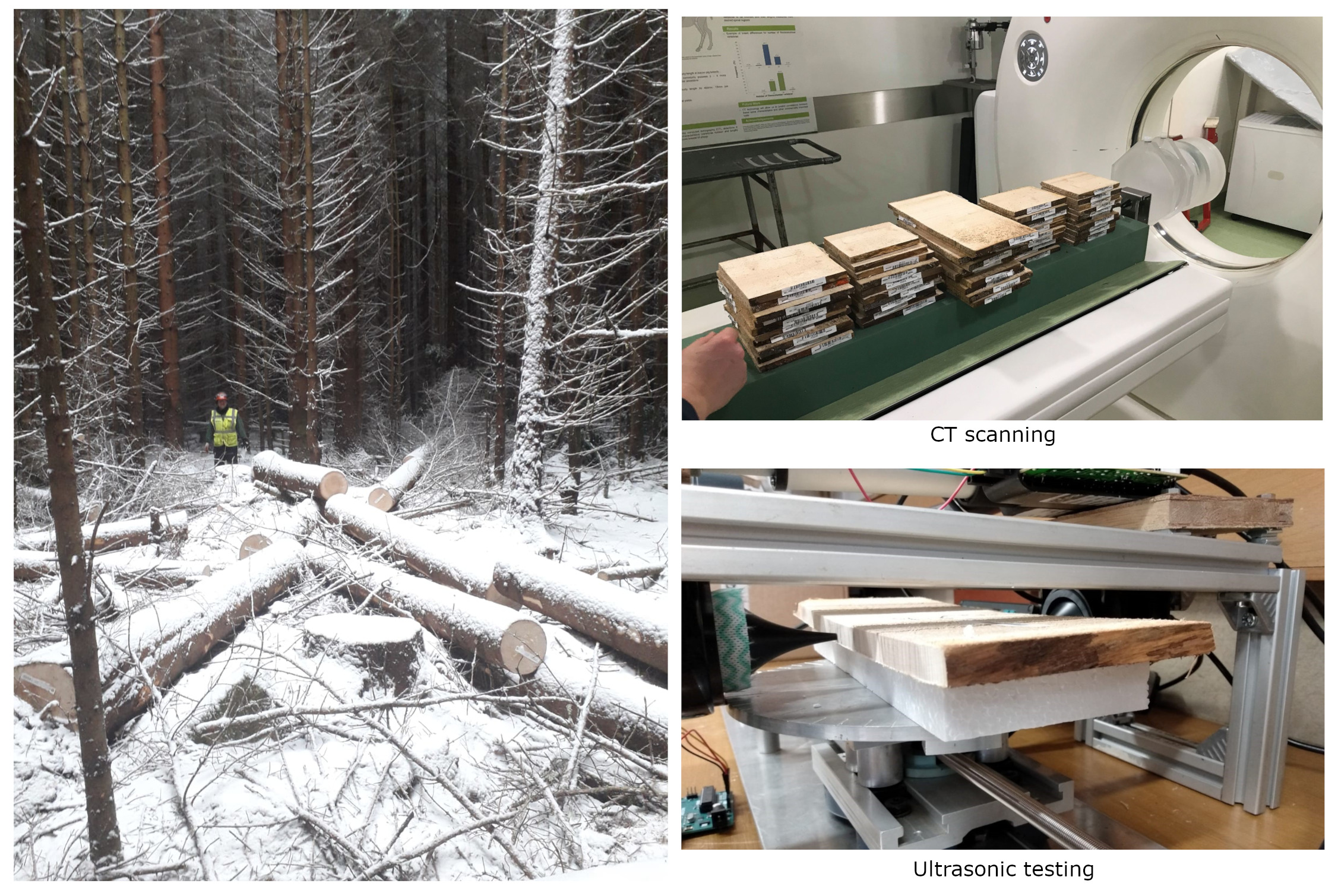
Following an assessment of diameter at breast height (DBH), selected sample trees were felled in a provenance trial planted in 1974 at Farigaig near Foyers, south-west of Inverness. The trial was comprised of 25 origins of Sitka spruce, spanning most of the native range from Oregon to Alaska. Acoustic velocity measurements made on three logs cut from each of the felled trees were used to estimate wood stiffness at a log level. Crosssectional discs were removed from each log in one replicate and processed to produce samples for x-ray CT scanning to assess wood density at a growth ring level. These samples were then further processed in preparation for ultrasonic scanning, which will shortly be completed to provide ring-level assessment of wood stiffness. Analysis of DBH data showed a trend of declining basal area with increasing latitude of seed origin (provenance), and a slightly stronger trend of increasing basal area with increasing mean annual temperature at the seed origin location. The best performing provenances for basal area came from the Haida Gwaii (QCI) and Washington zones. Variability in wood stiffness (estimated from log acoustic velocity) was mainly due to differences within and between trees, with less than 5% of the variation accounted for by differences among provenances. Wood stiffness did not appear to be affected by latitude of seed origin, although a possible marginal effect of mean annual temperature was observed. Variation in wood stiffness will be further examined when data from the ultrasonic scanning of discs are available. Significant differences in wood density among provenances were observed but there was no clear pattern relating wood density to seed origin latitude or climate. There was a trend of increasing wood density with increasing stand density (trees ha-1). Plans are in place to complete ultrasonic scanning of samples from the first replicate and to cut sample discs from the second replicate, which will also undergo x-ray CT and ultrasonic scanning (this work has been delayed due to COVID).