Who Will Pay for Urban Forest Climate Regulation Services?
Carried out by: Southampton University/Forest Research
Summary Description:
This PhD research project is a collaborative undertaking between the University of Southampton and Forest Research to analyse the extent to which Payments for Ecosystem Services (PES) schemes can promote investment in urban woodlands as a means of minimizing the impacts of climate change in
built‐up areas.
Specific research questions are:
(1) Who is best suited to provide urban woodland ecosystem services?
(2) What is the magnitude of willingness-to-pay (WTP) for these services?
(3) How do time, uncertainty and knowledge affect WTP and thus PES design?
(4) Would a voluntary or institutional PES be more appropriate?
Methods will include a literature review, GIS mapping to identify three case studies, choice experiments with a range of experts and multi-criteria analysis.
Outputs will include the PhD, three journal papers and at least two conference presentations.
Timescale: 2015-2018
SFT Funds Awarded: £11,986
Project Outcomes:
Urban forests offer a nature-based solution to problems such as surface water flooding, urban heat islands, and air pollution through their provision of regulating ecosystem services (ES). Despite this, local government budgets for tree planting and maintenance have declined across the UK, and the extent to which urban forests are planned and managed with these ES in mind is unclear. A possible way of increasing funding for urban forest-based regulating ES is through a beneficiary pays model, i.e. a business- or citizen-financed ‘payments for ecosystem services’ (PES) scheme. However the academic literature has so far neglected this possibility, and such schemes are lacking in practice.
This project used a mixed methods approach with different stakeholder groups to help fill these research gaps and inform local and national government decision-making. In-depth interviews with local government tree officers from 15 of the UK’s most densely populated cities revealed a number of constraints and opportunities for enhancing provision of urban forest-based regulating ES. Using the UK city of Southampton as a case study, the project then ascertained interest amongst beneficiaries for financing this enhanced ES provision. Questionnaire-based interviews with 30 businesses of varying sizes and sectors revealed their overwhelming support for contributing to Southampton’s urban forest (particularly the ES of air purification). However, despite the presence of moral motivations, most businesses would prefer to contribute on a voluntary basis for marketing and corporate social responsibility purposes. Finally, a discrete choice experiment conducted with 339 citizens revealed significant, positive willingness-to-pay (WTP) for the urban forest-based ES of stormwater attenuation, air purification, and aesthetic beauty. Furthermore, WTP for street tree planting was found to be higher when citizens were aware of the benefits of trees and the uncertainties surrounding their provision, than when these benefits were seemingly assured, but poorly understood.
SFT/FC Joint Bursary Award Scheme:. This project has received funding from the SFT/FC Joint Bursary Award.
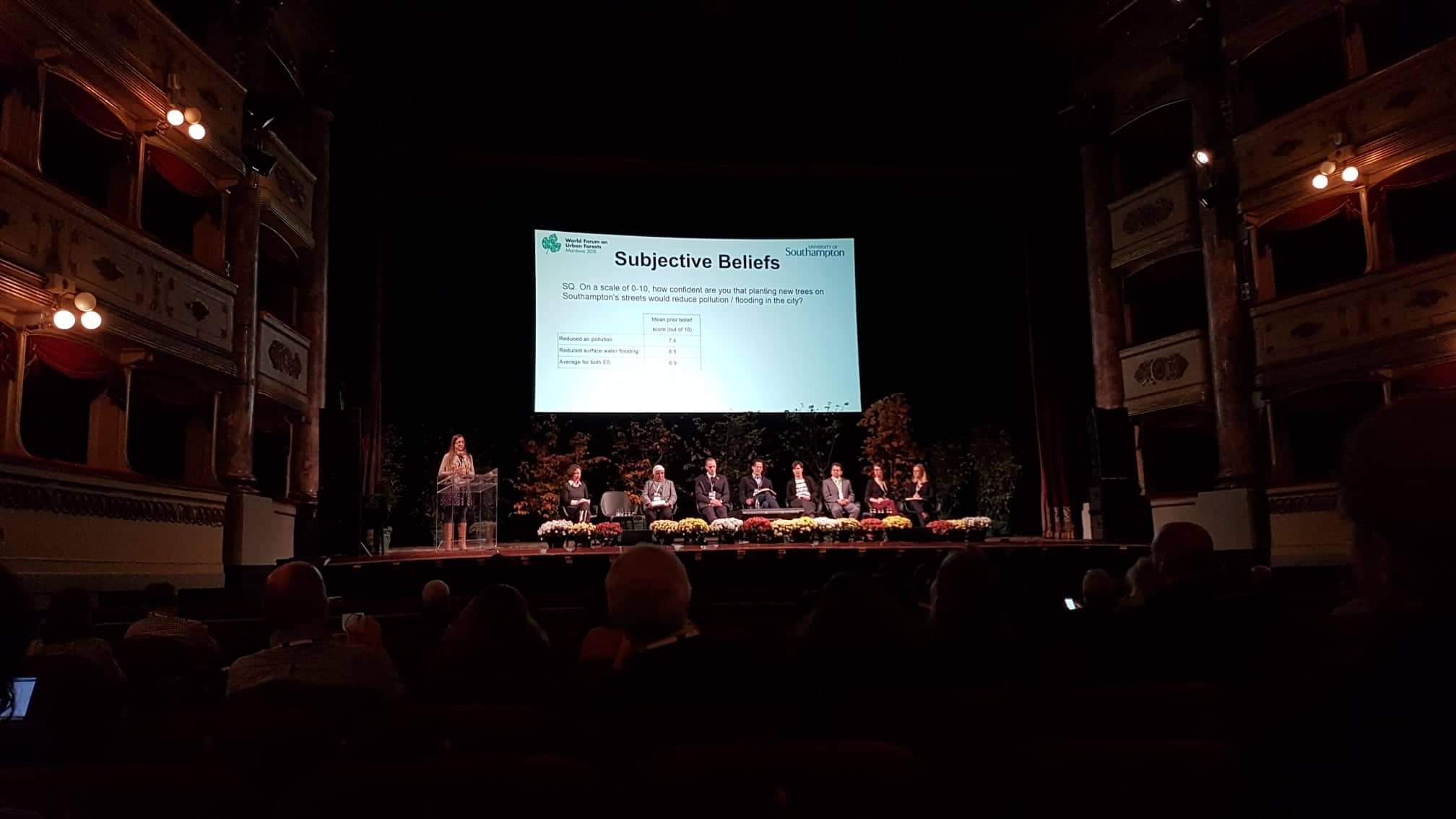 Hudson-Davies Presentation at World Forum on Urban Forests Nov 2018