
Improving Biodiversity in Lowland Planted Woodlands
Carried out by: Falkland Stewardship Trust/Dr Rick Worrell
Summary Description:
Woodlands planted on arable land and improved pasture fail to develop woodland plant communities and remain dominated by grass and agricultural weeds; even in old woods. This severely limits their biodiversity value, including impacts on some invertebrate populations; and reduces the amenity and recreational appeal of the woods.
This can be addressed via careful introductions of missing woodland plant species aimed at simply establishing small viable populations that can colonise the wood over time. There are a few trials of woodland plant introductions in Scotland and England; but none have used this approach and are suitable for long term monitoring and research.
Research Objectives:
a) Establish long term demonstration sites to test the feasibility of introductions, provide evidence of outcomes, refine methodology and seek cost-effective approaches.
b) Arrange training events focused on good conservation management of lowland planted woods.
Outcomes:
1) a paper(s) describing improved management practices;
2) enhanced understanding and professional capacity amongst managers;
3) a long term research resource;
4) a student dissertation.
Timescale: 2017-2020
SFT Funds Awarded: £2,500
Project Outcomes:
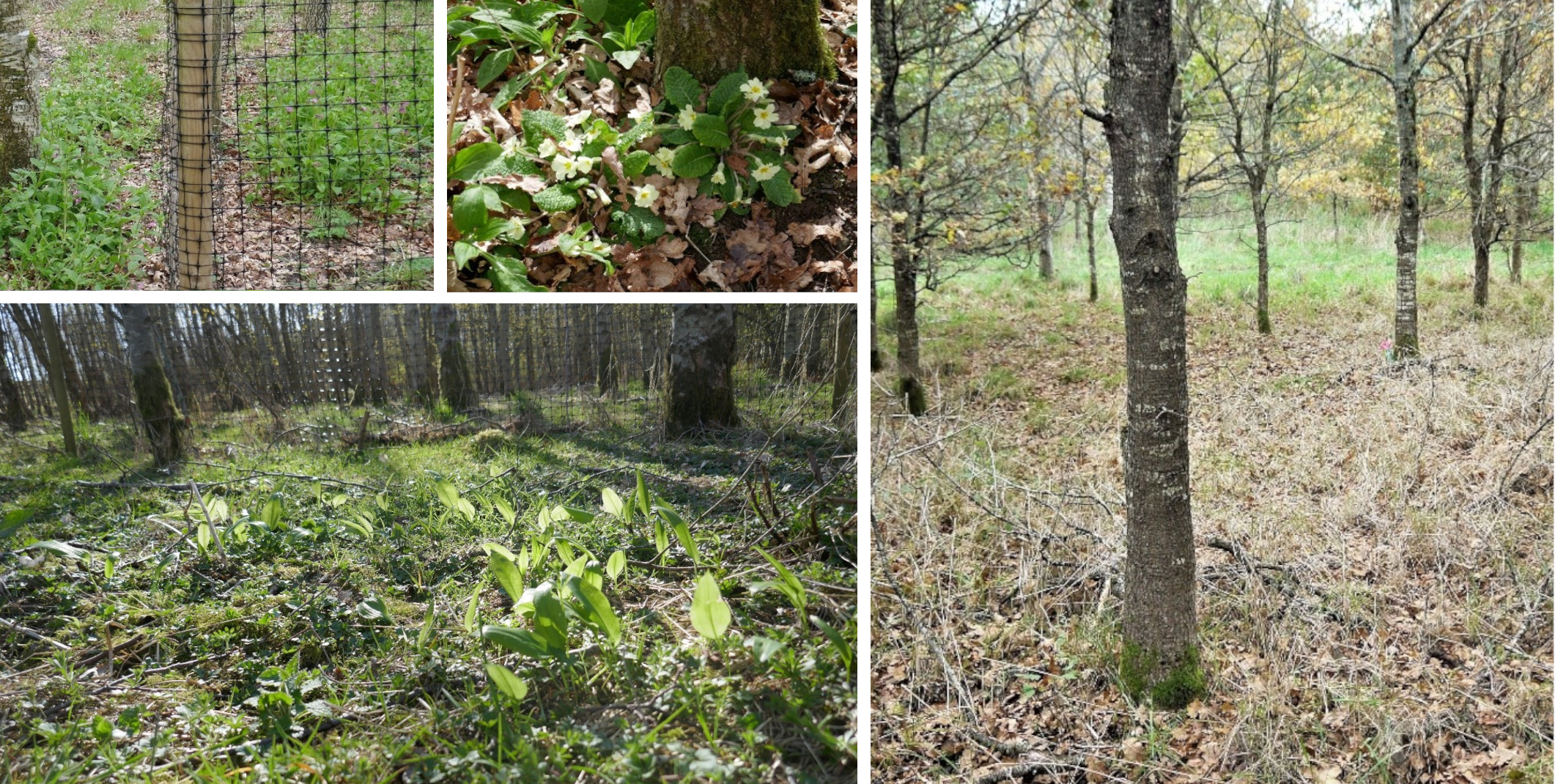
Major Conclusions and Lessons:
- Establishing “founder populations” (seed sources) of plants in small plots is a useful and relatively low risk way of initiating restoration of woodland plant communities. However the relative merits of confining these plantings to small plots as opposed to more dispersed planting patterns is unclear.
- A number of woodland plant species performed consistently quite well when seeded directly, whereas a few others performed poorly; with the remainder intermediate. The best performing species appear generally suitable for direct seeding, whereas the less successful species are better established as plug/potted plants.
- On some sites, establishment of plants will perform poorly for reasons that are not clear and practitioners should be vigilant in the early years to identify if this happening. There is a strong suspicion that molluscs are an important factor, and so control of these at or before time of planting should be considered.
- Local collection of seed and cuttings of a suite of common plant species is a time-consuming activity, especially if the sites are any distance away from the collector. The time and cost values in the Nature Scot interim guidance are under-estimates.
- Plants generally establish well from plug/potted plants, through losses can occur when planting takes place immediately before drought periods and on sites with particularly heavy oak leaf litter. It is useful to have some plug/potted plants of some species in reserve in case direct seeding fails or is only partially successful.
- Experience from this project generally points in the direction of using plug/potted plants more widely and direct seed rather less, so as to have better control of outcomes. However use of plug/potted plants is not without risk either, especially where deer browsing occurs.
- When carrying out direct sowing, suitable seeding locations should be identified the during previous summer to reveal microsites reasonably free of competing vegetation.
- A number of species established fairly satisfactorily in the face of some deer browsing, and restoration efforts could be centred on these species on sites where deer control is difficult. Browsing appears to affect the outcomes quite strongly, especially flowering, though this aspect was not quantified in these trials.
- Even simply establishing seed sources of woodland plants is quite a long term process – and was clearly incomplete after five years.
- The progress of colonisation of the woodland from these plots is still unknown, is difficult to predict and is likely to take a long time.
- It is important to keep records of costs for at least the first 3-5 years.
- The approaches and techniques set out in the interim best practice guidance Nature Scot publication (Worrell et al. 2021) is broadly sound, but the findings of this project could be used to refine aspects of the guidance.