
Epidemiology of Phytophthora ramorum on Larix spp. and host responses to infection
Carried out by: Forest Research/Oxford University
Summary Description:
Forest ecosystems in Britain are highly vulnerable to invasive Phytophthora spp., including Phytophthora ramorum, which is causing severe economic losses to larch across the west of the country. This PhD project aims to investigate natural resistance in larch to P. ramorum by studying disease epidemiology and variations in host response. This will enable a greater understanding of the potential to exploit natural resistance/tolerance to P. ramorum in a larch breeding programme.
The specific project objectives are; i) investigate the epidemiology of P. ramorum on larch in SW Scotland, ii) determine whether differences in susceptibility occur between European larch (EL) and Japanese larch (JL) to EU1 and EU2 lineages of P. ramorum, and iii) examine the molecular interactions between P. ramorum and JL and EL in order to identify key host immune responses.
Timescale: 2016-2019
SFT Funds Awarded: £60,000
Project Outcomes:
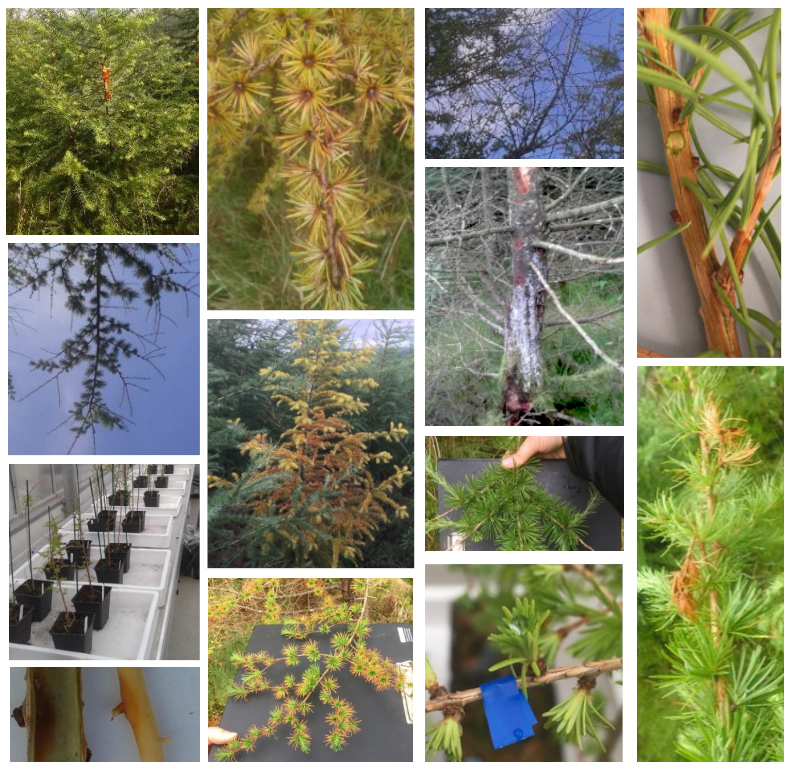
Thesis Abstract
Phytophthora ramorum is responsible for disease outbreaks in a range of species, most prominently Sudden Oak Death in the USA and Sudden Larch Death in the UK. Our study focuses on the interactions between P. ramorum and two important forestry species in the UK, European larch (Larix decidua Mill.) (EL) and Japanese larch (Larix kaempferi (Lamb)Carr.) (JL). Larches are the third most important conifer species in the UK, with 126,000 hectares planted. By 2019 at least 20,700 hectares of larch had been killed due to P. ramorum infection or felled in efforts to contain the pathogen. Despite containment efforts, P. ramorum is expected to continue to spread and cause high levels of mortality in larch stands. Understanding the factors affecting spread, the response of larches to infection and the possibility of resistance to P. ramorum occurring within the larch population would help improve disease management.
This work aimed to increase our understanding of the epidemiology of P. ramorum through a study of the natural infection processes and disease progression of P. ramorum in JL in south-west Scotland over a multi-year period. The region had suffered an extensive epidemic in 2012 from a highly virulent new lineage (EU2) and a second period of increased spread in spring 2018, which allowed us to examine how P. ramorum infects individual trees and spreads across sites over a prolonged time. Using records from these two outbreaks, we considered how environmental conditions influence outbreaks and identified increased summer precipitation, cold temperatures in winter and early spring, spring storm winds and spring snowfall as important factors. Our field observations predict buds on fine shoots as sites of primary infection, with infection occurring between late autumn and flushing in the spring, followed by rapid lesion expansion during spring. Comparisons between the larch stands in our study area showed that infection and spread, and the response to that infection, varies within and between sites. In younger stands most trees died within 6-12 months of first infection but some still survived, although with severe branch dieback, more than three years later. Older stands with >95% mortality had occasional very healthy trees at least seven years after first reported infection.
EL was reported to be less severely affected by P. ramorum infection in field conditions than JL. We conducted inoculation experiments on potted JL and EL saplings and carried out RNA-seq analysis to study the RNA transcript accumulation profiles in response to inoculation with P. ramorum. Although similar in terms of lesion development, there was an interesting difference in expression of key defence pathways between the two species. EL had rapid induction of defence genes within 24 hours of infection followed by sustained or increasing expression until 25 days after inoculation. By comparison, results in JL were more varied with fewer key defence pathway genes clearly 4 responding to infection and the observed gene expression increases were both larger and more transient compared to EL.
The forest industry has great interest in retaining JL as a commercially viable timber species through the possibility of breeding for resistance to P. ramorum. This study is the first to investigate variation in resistance to P. ramorum in the JL population through inoculation of a clonal trial derived from putatively tolerant survivor trees and known susceptible trees. We found quantitative variation in susceptibility to P. ramorum within the JL population with some clones showing significantly shorter lesions than others. We propose that these clones, showing lower susceptibility, could be a useful starting point for further work investigating natural resistance in larch.
SFT/FC Joint Bursary Award Scheme:. This project has received funding from the SFT/FC Joint Bursary Award.