
Efficacy of One-Way Hare Structures in Woodland Areas
Carried out by: Scottish Woodlands
Summary Description:
This project aims to investigate the effectiveness of one-way structures in allowing hares to escape from fenced woodland enclosures. This will be done through implementing innovative exit structures to allow for the safe passageway of hares, and to subsequently monitor the use of the structures by hare species through the implementation of camera traps. This will allow for a greater insight into the behaviour of hare species, and into the practicality of exit structures in protecting newly planted trees against hare damage. Furthermore, this will set a precedent for greater research into more effective alternatives to hare management within the forestry industry.
Timescale: 2022-2023
SFT Funds Awarded: £3,360
Project Outcomes:
Report Summary
The forestry industry is currently limited as to how hares can be managed within fenced woodland enclosures to reduce damage to newly planted trees. Increased legal protection has also raised the profile of mountain hares and set the precedent for greater considered management of the species within woodland sites. However, understanding of hare behaviour within fenced woodland enclosures is limited, and more effective alternatives to current hare management strategies are needed. Therefore, this study aimed to investigate the effectiveness of one-way structures in allowing Brown hares (Lepus europaeus) and Mountain hares (Lepus timidus) to escape from fenced woodland enclosures, as well as to provide a greater insight into the behaviour of Brown hares and Mountain hares within fenced woodland sites.
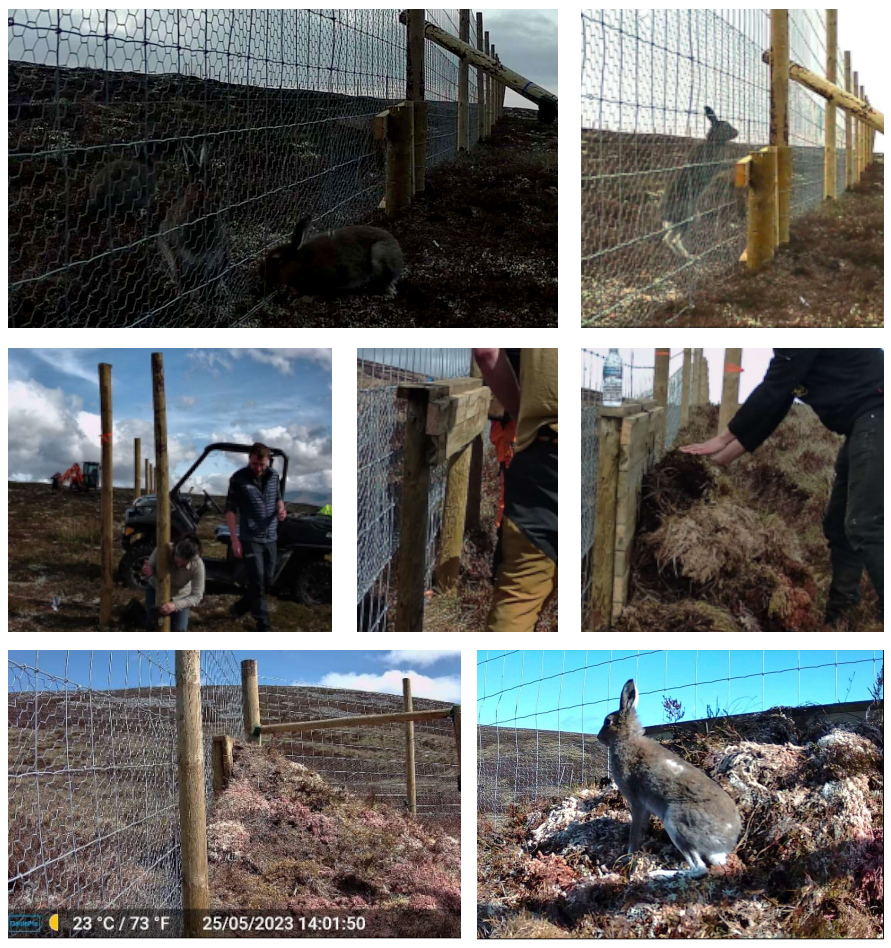
This was done through the creation of one-way gates and ramps and monitored through the implementation of motion-sensor camera traps. The findings indicate that hares will use one-way structures to exit enclosures. Both gate and ramp structures were found to be successful though ramps showed higher levels of use and provided additional benefits in areas where snow fall was high. All exits from the enclosure using these structures occurred at the corner location, indicating greater effectiveness in fenced corner locations. The successful use of the one-way structures suggests a degree of effectiveness suitable for further research, and these findings should be used to develop more effective strategies of hare management in future.
The full report can be read here.