Alternative techniques for managing Hylobius abietis
Carried out by: Forest Research
Summary Description:
The large pine weevil (Hylobius abietis) is the most serious pest of newly planted or naturally regenerating woodland trees on restocking sites in Scotland and the rest of the UK and Ireland.
The need to find alternatives to the use of existing insecticides or a fallow strategy have led to a 10 year, collaborative research effort across the UK forest industry involving Forest Research, UPM Tilhill, Maelor Nurseries, Forest Enterprise England, Forest Enterprise Scotland, Natural Resources Wales, the Northern Ireland Forest Service, Coiltte, Confor, Scottish Woodlands, and Swansea University, along with a range of other important stakeholders.
This research investigated a range of innovative techniques for the integrated management of Hylobius abietis.
The objective of this Scottish Forestry Trust project is to produce a number of open access, independently peer reviewed scientific papers to report on this research, and to provide an evidence base for decision makers in the sector considering options for managing Hylobius abietis, and for stakeholders interested in the rationale for current forest practices.
Timescale: 2019
SFT Funds Awarded: £5,000
Project Outcomes:
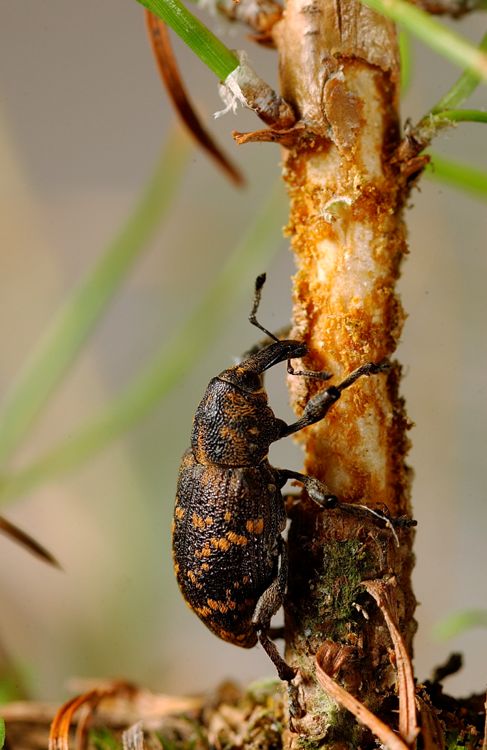 The large pine weevil (Hylobius abietis) is the most serious pest of newly planted or naturally regenerating woodland trees on restocking sites in the UK and Ireland. On affected sites, in the absence of protective measures, losses of replanted trees will average around 50%, but in the worst cases all trees can be killed. The need to find alternatives to the use of synthetic pyrethroid insecticides led to a collaborative research effort across the UK forest industry which investigated over 100 different approaches on 22 different trials sites. A number of less toxic insecticides were identified that can effectively protect trees, as well as non-chemical approaches that may work when on site populations of Hylobius are predicted to be lower.
How have the results been used?
Two scientific papers have been produced fully reporting on the results of these experiments, and they are freely available as follows:
Moore, R., Willoughby, I.H., Andrew J. Moffat, A.J. and Forster, J. (2021). Acetamiprid, chlorantraniliprole, and in some situations the physical barriers MultiPro® or Kvaae® wax, can be alternatives to traditional synthetic pyrethroid insecticides for the protection of young conifers from damage by the large pine weevil Hylobius abietis L. Scandinavian Journal of Forest Research, https://doi.org/10.1080/02827581.2021.1906313
Willoughby, I.H., Moore. R., Moffat, A.J, Forster, J., Sayyed, I. and Leslie, K. (2020). Are there viable chemical and non-chemical alternatives to the use of conventional insecticides for the protection of young trees from damage by the large pine weevil Hylobius abietis L. in UK forestry? Forestry 93 (5), 694–712. https://doi.org/10.1093/forestry/cpaa013