
Preventing floods with natural solutions
Posted on
In the run-up to Christmas, The Scottish Forestry Trust was proud to support Dr Martina Egedusevic of the University of Exeter in attending the Future Leaders Summit 2025, in Sarajevo, where she hosted a workshop on flooding and nature-based solutions. In this blog post, Martina reports on the summit and the insights gained from the experience.
Floods, landslides, and extreme rainfall are increasingly shaping life across the Western Balkans. In recent years, communities have experienced firsthand how climate change, land-use pressures, and environmental degradation combine to amplify disaster risk. But what if working with nature, rather than against it, could help reduce these impacts?
On 19 December 2025, I led a dedicated workshop at the Future Leaders Summit 2025 in Sarajevo entitled Preventing floods with natural solutions. The workshop brought together young leaders, researchers, policymakers, and practitioners to discuss how nature-based solutions (NbS) can play a meaningful role in flood risk reduction and climate resilience.
NbS include measures such as restoring rivers and floodplains, improving soil health, planting riparian woodlands, and managing land more sustainably across entire catchments. These approaches are increasingly recognised across Europe for their ability to reduce flood peaks, slow runoff, stabilise soils, and deliver co-benefits for biodiversity, water quality, and local livelihoods. Yet across much of the Western Balkans, these solutions remain underexplored or disconnected from policy and practice. The workshop created space to connect science, governance, and lived experience, focusing not just on theory but on what works in practice and what stands in the way.
The workshop was designed as an interactive and participatory session. The workshop combined short inputs, open discussion, and shared reflection. Participants explored,
- Real-world examples of NbS from Europe and the region
- How land management, forestry, and soil practices influence flood risk
- The role of institutions, communities, and young professionals in shaping resilient futures
- How local knowledge and regional experience can inform international frameworks
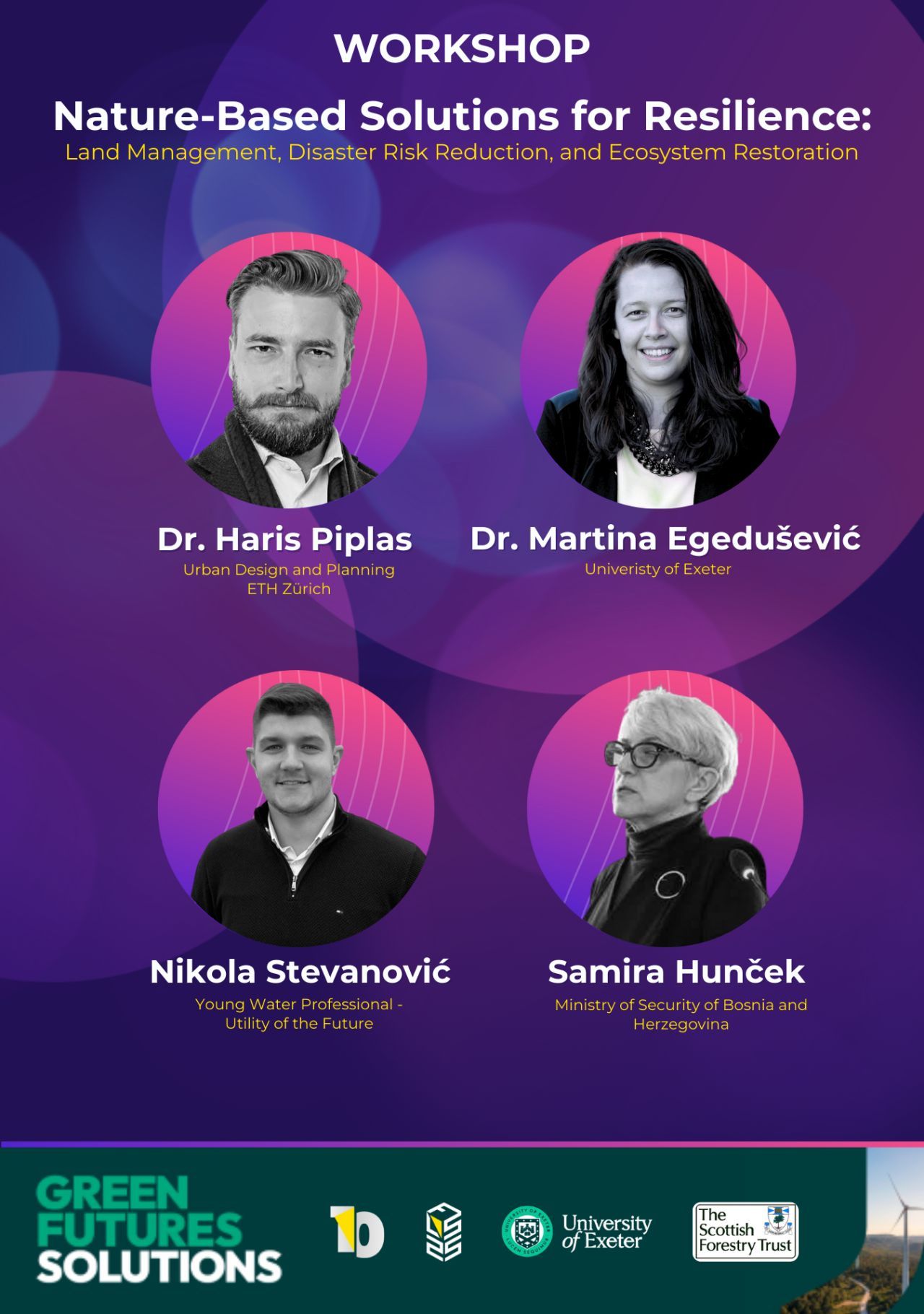
The workshop featured contributors from the University of Exeter, ETH Zürich, Utility of the Future and the Ministry of Security of Bosnia and Herzegovina. Speakers offered perspectives spanning academic research, policy implementation, and applied practice with a strong focus on empowering future leaders to engage with climate adaptation and disaster risk reduction.
Rather than ending when the workshop finished, discussions and insights informed a short post-event synthesis that captured key messages, lessons, and opportunities for collaboration. This output will be shared with regional and international networks, including UNCCD, OSCE, and UNEP, helping ensure that voices from the Western Balkans contribute to wider conversations on climate resilience.
As climate risks intensify, the need for solutions that are effective, inclusive, and locally grounded has never been greater. By bringing together young leaders and experienced practitioners, the workshop sparked conversations that will extend beyond a single event and contribute to more resilient landscapes and communities across the Western Balkans. Because sometimes, the most powerful solutions are already rooted in nature.